There are two kinds of construction programmes in Phuket: those that account for monsoon, and those that fail in October. The first kind looks slower on paper. The second one slips an entire dry season trying to recover what the rain ate. Build a programme on the assumption that the weather will cooperate and you have already lost.
Three months into the dry season is a useful time to think about it, because if you're starting a build now and your programme assumes you'll be doing the weather-sensitive work in July, the conversation about that needs to happen before the first slab is poured.
What "monsoon" actually means for a programme
Phuket's monsoon runs roughly May through October. That's not seven months of constant rain, it's seven months of significant rain. Most days have at least one downpour, some days have all-day weather, and a small number of days have storm-grade conditions that close site entirely. Annualised rainfall sits around 2,200–2,500 mm, with the heaviest concentration in September.
The implication isn't that work stops. The implication is that some specific tasks become high-risk during this window:
- Cast-in-place concrete. Pours have to be timed against forecasts; covers and tarps come on; cure times slow down or stretch under humidity. Quality risk goes up.
- Surface coatings. Paint, render, sealants, anything sensitive to ambient humidity or surface moisture. Many products simply won't apply correctly above 80% RH, and Phuket's monsoon delivers that for weeks.
- Electrical first-fix in open structures. Wet enclosures and saturated subgrade are a regulator problem.
- External tiling and masonry. Adhesives don't bond well to wet substrates; mortar dilutes; finishes streak.
- Earthworks and slab subgrade prep. The first-meter clay across most of Cherngtalay turns to mud quickly. Compaction quality drops; programme slips while waiting for ground to dry.
The four tactics we use
None of these are clever. Most of them are mostly discipline. Together they make the difference between a programme that holds and a programme that pretends.
1. Front-load weather-sensitive tasks before May.
The easy answer is: get the weather-sensitive work done in the dry season. The harder part is having the design and procurement ready early enough to actually pour concrete, do the structural envelope, and get the building weathertight before the rains start. This requires the design package to be locked, contracts in place, and trades mobilised by January at the latest. Anything later cuts into the dry-season runway.
2. Schedule interiors for the wet months.
Once a building is weathertight (roof on, walls in, glazing installed) the interior trades can run regardless of the weather outside. So the right move is to land the envelope before May, and use May–October for first-fix services, drylining, joinery, tiling, and finishes. Sites stay productive; trades stay warm and dry; the programme doesn't slip.
3. Build buffer into the critical path, not at the end.
A naive programme places contingency at the back end, a few weeks of float before handover. That doesn't help when the slip happens at week four because of a wet-season pour. Useful contingency lives in the critical path itself, distributed across the weather-sensitive stages. We typically size foundation and structural durations against a 40–50% wet-day assumption rather than a clear-weather one.
4. Use precast to remove weather from the critical path.
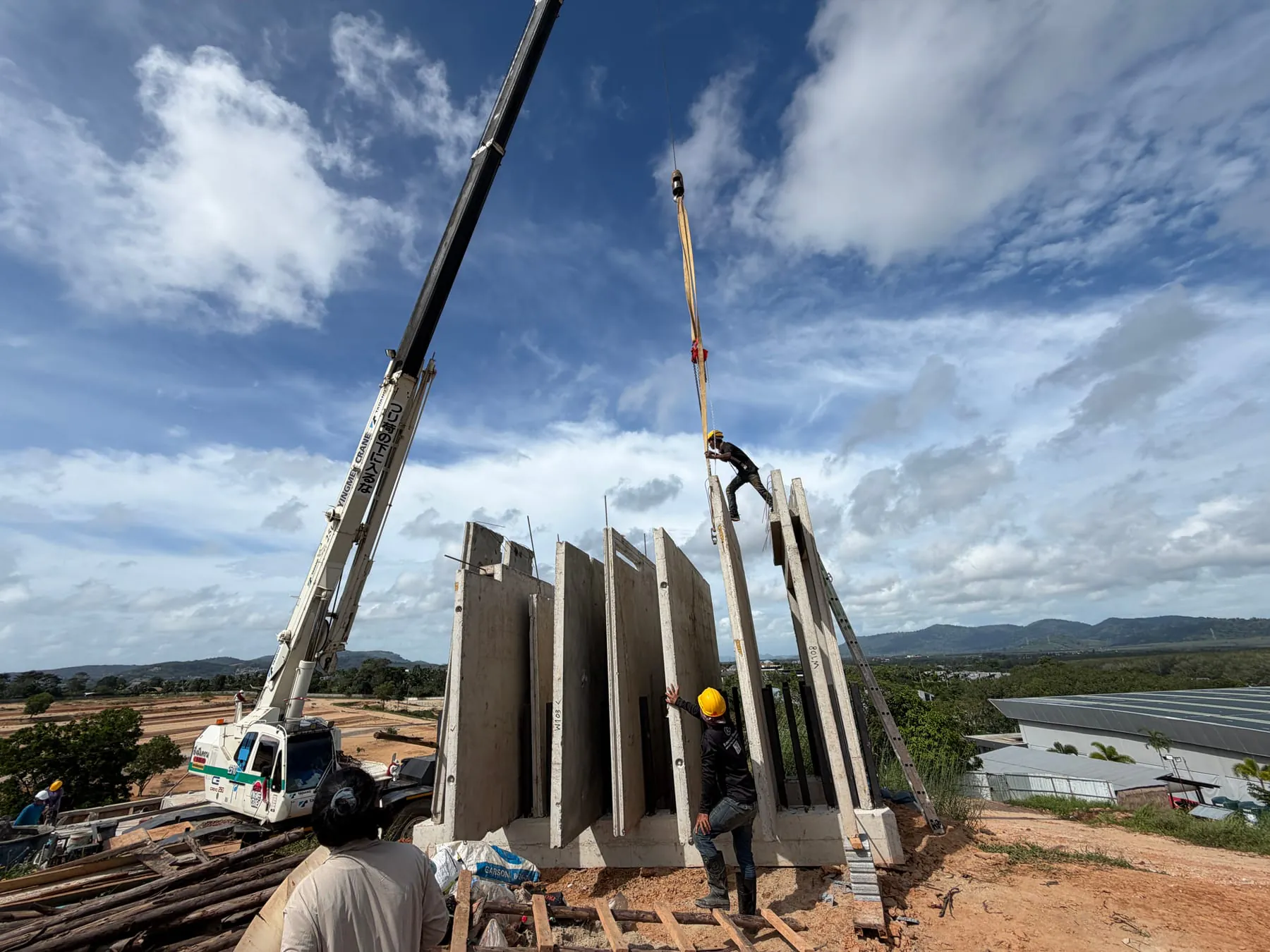
The structural method that survives a Phuket monsoon best is precast, components are cast and cured at a factory, not on the plot. Erection on site happens in days under whatever weather is going. We've written about this method in detail on the precast technology page, but it's worth flagging here as a programme tool: precast doesn't just save time on average, it saves time specifically when the weather is at its worst.
Build a programme on the assumption that the weather will cooperate and you have already lost.
The discipline of saying no
The hardest version of this is the discipline of saying no. We've turned down briefs that asked for foundation pours in August, on the assumption that the contractor will "make it work." We've also turned down briefs whose programme had no contingency for weather and whose owner didn't want one. These are not jobs we can underwrite without overpromising, and overpromising on a Phuket build is how you end up with the kind of project a rescue team has to take over the following year.
Our preference is the conversation that ends with a programme everyone agrees is honest. That programme might be slower than the one the client started with, but it's the one that lands.