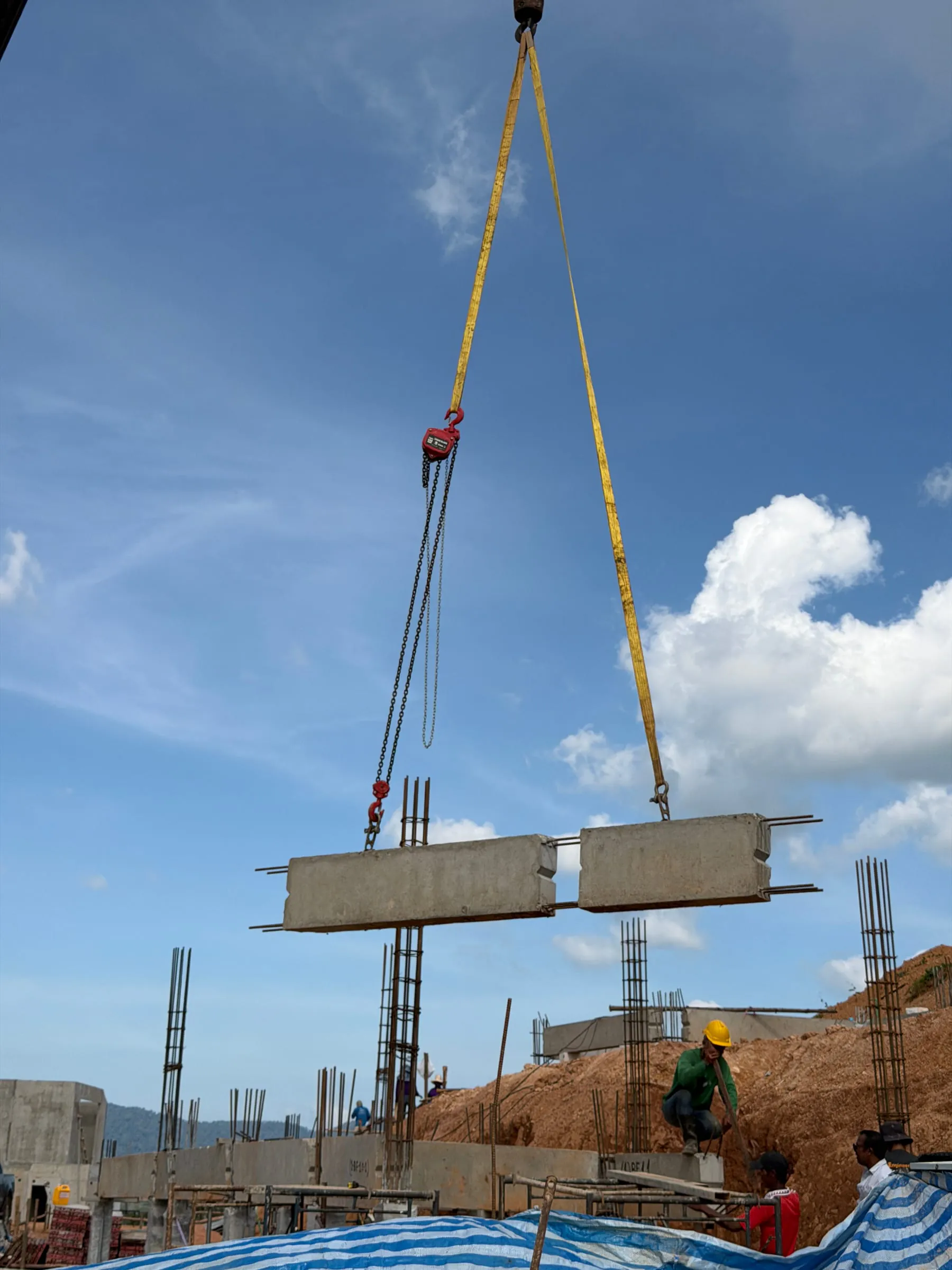
There are two ways to build a concrete villa in Phuket. The standard way is to cast it in place, pour the structure on site, in formwork, and wait for it to cure under tropical conditions. The other way is to cast it off-site, cure it in a controlled-conditions factory, and crane the cured components into position on the plot. We do the second one.
This article is the public version of an explanation we give every owner who asks why their plot looks quiet for the first month of construction while the project's overall progress is racing ahead. It's also useful for any developer or principal making a serious decision about which method to specify on a multi-villa programme in Southeast Asia.
What precast actually is
Precast concrete is concrete that has been cast in moulds at a dedicated facility, cured to dimensional spec, and delivered to site as a finished structural component. Walls, structural panels, stairs, and ground beams all arrive on site already cured and ready to install. The work on the plot becomes erection, positioning, connecting, sealing, rather than forming and pouring.
The technique is unremarkable in northern Europe, Singapore and Japan. It is increasingly the default for higher-spec residential and hospitality projects across Southeast Asia. In the Phuket residential market, however, the working assumption is still cast-in-place. Most local contractors aren't set up for the procurement, logistics or coordination required to run precast at scale, and most clients haven't been given the comparison in numbers.
What it does for the programme
The single biggest reason we use precast is the Phuket monsoon. From May through October, about seven months in any given year, there is enough rain to disrupt cast-in-place work meaningfully. Tarps come on, dewatering becomes routine, slab cures slow down, and the programme either pads out to absorb the slip or cuts corners on cure time. Precast removes most of that risk because the curing is happening under a roof at a factory.
The numbers we see on site are consistent: a typical villa is about 45% complete by the end of Month 2 of its individual build window. Foundations and structural shell are in place. The next four months are largely interior, and the building is weathertight long before that. By comparison, a traditional cast-in-place villa is still curing slabs at the same point.
By the end of Month 2 of any individual villa's eight-month programme, the structure is typically already 45% complete, a pace cast-in-place cannot match in a market with a seven-month monsoon.
What it costs
The trade-off is in coordination. Precast doesn't reduce material cost meaningfully versus cast-in-place. Sometimes it's a wash, sometimes it's a small premium. But it changes where the project carries risk. The risks shift from "how do we deal with the weather and the cure" to "how do we coordinate factory delivery slots, cranage, and site access."
Concretely, we plan against three things:
- Factory delivery slots have lead times. The precast factory needs commitment in advance. Late changes to a wall's openings or dimensions are expensive once they're in the production schedule.
- Cranes have to be sized correctly. Precast wall panels are heavy. The crane choice has to match the longest reach and the heaviest panel, not just the average. Wrong crane = day-rate problems and erection errors.
- Site logistics for staging. Panels need a place to land between truck and lift. We programme the site to receive them in batch order, not random arrival.
None of these are difficult to solve, but they require the construction team to be planning four to six weeks ahead at all times. A team running off improvisation will lose money on precast. A team running off documentation won't.
Where it fits, and where it doesn't
Precast is at its strongest on residential at scale and hospitality with repetitive room types, anywhere a typology repeats and the factory can amortise the mould. Our clearest current example is at KAHLI Phuket, where 19 hillside villas across three configurations all share a common precast set of structural panels.
It's less applicable for one-off bespoke villas where every wall is different. The factory mould amortisation breaks down. For those projects, cast-in-place can still be the right call, it just has to be programmed and supervised against weather as a known risk, not as a surprise.
What it means for an owner
If you've bought into a development that's running precast, the most useful thing to know is that your individual plot will look quiet for longer than feels comfortable, and then everything will happen at once. Foundations and ground beams might take a few weeks. Walls go up in days. The shell is suddenly there. Then four to six months of interior work follow, looking like progress has slowed, but the building is weathertight, the trades are warm and dry, and the finishing work is happening on schedule.
This rhythm is fundamentally different from a cast-in-place build, where progress looks linear and continuous from the outside. Owners briefed only on cast-in-place often misread the precast curve as a delay. It isn't.
The full nine-stage timeline, with month-by-month progress and the per-villa programme breakdown, lives on the studio's precast technology page.